
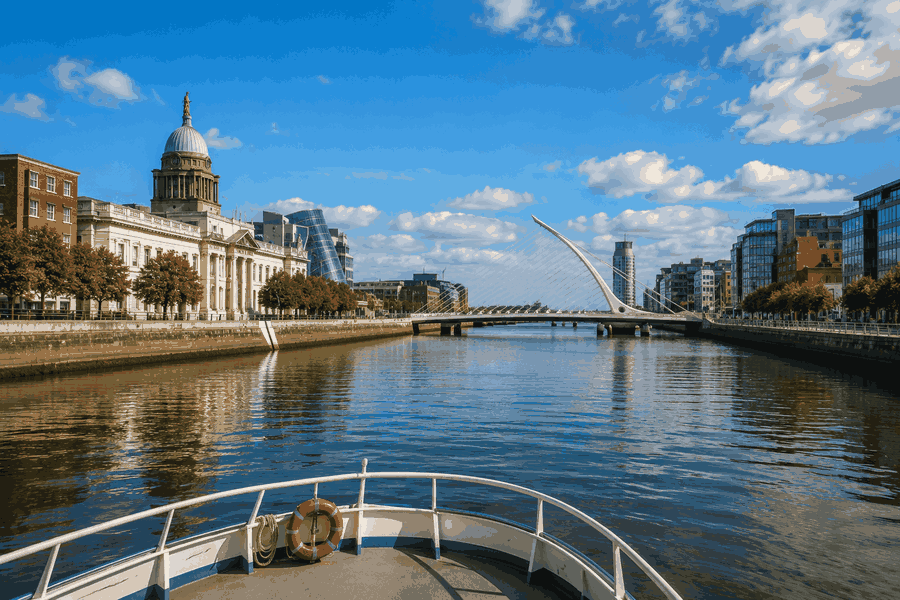
What to See on a River Liffey Cruise in Dublin
A River Liffey cruise gives you a water-level view of Dublin's historic quays, the Custom House, O'Connell Bridge, the Docklands, Jeanie Johnston and the distinctive Samuel Beckett Bridge.
The standard sightseeing cruise lasts around 45 minutes and travels from the Seán O'Casey Footbridge area through central Dublin and east toward Dublin Port before returning.
It's not a long-distance river cruise.
Instead, the experience brings together several centuries of Dublin in a relatively short stretch of river.
You'll see Georgian architecture, reminders of Dublin's maritime past and some of the city's most modern developments—while live commentary explains how the River Liffey helped shape the city around it.
Here's what to look out for.
River Liffey Cruise: What You'll See
Sight | Why Look Out for It |
|---|---|
Seán O'Casey Bridge | Starting area and gateway to the Docklands |
O'Connell Bridge | One of central Dublin's best-known crossings |
Georgian Quays | Historic riverfront architecture |
Custom House | One of Dublin's landmark riverside buildings |
Jeanie Johnston | Reminder of Ireland's emigration history |
Dublin Docklands | Where historic port Dublin meets the modern city |
Samuel Beckett Bridge | Harp-inspired contemporary Dublin landmark |
Dublin Port direction | Reveals the Liffey's connection with the sea |
If this is your first visit
Pay particular attention to the Custom House, Georgian Quays, Jeanie Johnston and Samuel Beckett Bridge.
Together, they show how dramatically Dublin has changed while the Liffey has remained at the centre of the city.
1. Seán O'Casey Bridge and the CHQ Area
The sightseeing cruise begins on the north side of the River Liffey near the Seán O'Casey Footbridge, opposite the CHQ Building.
Before the boat even departs, take a look around.
You're already in one of the most interesting parts of Dublin's modern waterfront.
The Seán O'Casey Bridge opened in 2005 as part of the regeneration of the Docklands and provides a pedestrian connection across the Liffey. Dublin City Council describes it as one of the area's important modern bridges.
This is also a useful area to explore before or after the cruise, particularly if you're visiting nearby Docklands attractions.
But once the boat leaves, the perspective changes.
Buildings that can feel disconnected when explored on foot suddenly become part of one continuous waterfront.
2. O'Connell Bridge
As the cruise travels toward central Dublin, it passes beneath O'Connell Bridge.
It's one of the city's major River Liffey crossings and connects the north and south sides of central Dublin.
From street level, O'Connell Bridge is busy.
From the water, you get a much clearer sense of how the bridge sits within the wider quayscape.
It's also a good moment to look beyond the bridge itself.
The river effectively divides Dublin's traditional Northside and Southside, and many of the streets, neighbourhoods and landmarks you'll explore during a city break developed around these crossings.
The bridges aren't simply convenient ways to get across the Liffey—they're part of Dublin's story.
3. Dublin's Georgian Quays
One of the most useful things about seeing Dublin by boat is understanding the quays as a whole.
From the river, you can see stretches of historic buildings and granite quay walls rather than experiencing them one street at a time.
The development of the quays transformed the Liffey over centuries as Dublin expanded and the river became increasingly contained by formal quay walls. By the 19th century, much of the modern quayscape had taken shape.
You don't need to know every building.
Instead, notice the relationship between:
the river
historic façades
bridges
quay walls
and
newer development.
That wider view is one of the things a boat tour does particularly well.
4. The Custom House
The Custom House is one of the architectural highlights of the cruise.
The 18th-century building occupies a prominent position beside the River Liffey and is specifically highlighted on the sightseeing route.
It's impressive from the street, but the river gives you a more natural view of the building's relationship with Dublin's historic port and quays.
This is worth remembering:
The Custom House wasn't simply built beside the river because the location looked attractive.
Its position reflects the importance of trade, shipping and the Liffey to Dublin's development.
As you pass, look back as well as forward.
The building can appear very different depending on your position on the river and the light.
5. Jeanie Johnston
As the cruise moves east toward the Docklands, look for the Jeanie Johnston.
The replica 19th-century emigrant ship sits beside the River Liffey and is one of the most recognizable maritime sights along this part of the route. The sightseeing cruise passes close to it before continuing beyond Samuel Beckett Bridge.
Visually, it also provides an interesting contrast.
Around it you'll see modern offices, bridges and redeveloped waterfront spaces.
Then, sitting beside all of that contemporary architecture, is a traditional tall ship.
It is one of the points on the cruise where old and new Dublin appear together in the same view.
6. Dublin Docklands
The Docklands section is one of the reasons we'd recommend paying attention to the live commentary.
If you simply look around, you'll see a modern business district.
But the area has a much deeper relationship with Dublin's port and industrial history.
Today, restored warehouses and maritime reminders sit alongside contemporary offices, apartments and large-scale modern architecture. The sightseeing route deliberately highlights this contrast as it moves east from the historic Georgian quays.
The transformation is particularly obvious from the river.
Instead of looking at individual buildings, you see the Docklands as an entire waterfront district.
For first-time visitors who spend most of their trip around Temple Bar, Trinity College and Grafton Street, this can reveal a very different side of Dublin.
7. Samuel Beckett Bridge
This is probably the most distinctive modern landmark you'll see.
The Samuel Beckett Bridge opened in 2009 and was designed by architect Santiago Calatrava.
Its cable-stayed design is intended to evoke the shape of an Irish harp, one of Ireland's national symbols.
The bridge spans 120 metres and its curved pylon rises 48 metres above water level. It can also rotate horizontally to allow maritime traffic to pass.
But you don't need the measurements to appreciate it.
Look at the bridge from the river rather than directly underneath it.
That's where the harp-like shape becomes much easier to recognize.
The contrast is also important.
Earlier in the cruise you're looking at Georgian Dublin.
Here, you're looking at an architectural symbol of 21st-century Dublin.
8. Toward Dublin Port
As the route continues east, the River Liffey begins to feel less like a city-centre river and more connected to Dublin's maritime identity.
The standard route extends toward the Thomas Clarke Bridge at the edge of Dublin Port before returning.
This part of the journey helps explain something that isn't always obvious when you're walking around Dublin:
The Liffey connects the city directly with Dublin Bay and the Irish Sea.
For centuries, the river wasn't merely something Dublin developed around.
It was a route for trade, travel and migration.
Dublin City Council's history of the Liffey traces that relationship all the way back to Viking longboats entering from Dublin Bay more than a thousand years ago.
You don't need a full history lesson during the cruise.
But understanding that relationship makes the journey toward the port much more meaningful.
What About the Ha'penny Bridge?
The Ha'penny Bridge is one of Dublin's most famous landmarks, so visitors often assume every River Liffey sightseeing cruise passes directly underneath it.
The standard Dublin Discovered sightseeing route, however, operates between the central city and Dublin Port and specifically travels beneath O'Connell Bridge rather than continuing farther west to the Ha'penny Bridge.
You should still visit it while you're in Dublin.
Opened in 1816, the cast-iron bridge was the first dedicated pedestrian bridge across the Liffey. Its famous nickname comes from the halfpenny toll originally charged to cross it.
Today it connects the area around Bachelor's Walk with Temple Bar and remains one of Dublin's most recognizable river landmarks.
Just don't book the cruise specifically expecting to sail beneath it.
That small distinction is worth knowing before you board.
Which Part of the River Liffey Cruise Is Best?
If architecture interests you, we'd choose the stretch around:
Custom House → Docklands → Samuel Beckett Bridge.
You see Dublin move from historic Georgian architecture into the modern city in a relatively short distance.
If you're more interested in history, pay attention to the commentary around:
the quays
Custom House
old port areas
and
Jeanie Johnston.
For photography, Samuel Beckett Bridge and the Custom House are likely to be among the strongest subjects.
Which Side of the Boat Should You Sit On?
We wouldn't worry too much about choosing a “perfect” side.
The cruise is a return journey, so your perspective changes as the boat travels along the Liffey and comes back.
Instead, prioritize a seat with a clear view through the windows or toward the open viewing area, depending on the boat and weather.
And don't spend the entire 45 minutes looking through your phone.
Some of the best views appear quickly as the boat passes bridges and waterfront buildings.
Is the River Liffey Cruise Good for Photography?
Yes—but think of it as urban photography, not dramatic landscape photography.
The strongest subjects include:
Custom House from the water
river reflections
historic quays
Jeanie Johnston
Samuel Beckett Bridge
modern Docklands architecture
and
bridges framing the city.
Because you're photographing from a moving boat, having your camera or phone ready before reaching each landmark helps.
Cloudy Dublin weather isn't necessarily bad either.
Soft light can work particularly well with the river, stone buildings and modern glass architecture.
How Long Do You Need?
The standard guided sightseeing cruise takes approximately 45 minutes.
That is enough time to see the main riverfront sights without taking a large part of your day.
We'd allow a little extra time before departure for boarding and avoid scheduling your next timed attraction immediately after the cruise.
The short duration also makes it easy to combine with other central Dublin attractions.
For most visitors, this isn't meant to replace a day of sightseeing.
It's a way to understand Dublin's waterfront before continuing to explore the city on foot.
Is Seeing Dublin From the River Worth It?
For first-time visitors, we think so.
The individual landmarks aren't the only reason.
You can see many of them while walking.
What changes from the boat is the relationship between them.
From the Liffey, you can watch Dublin transition from historic quays and Georgian architecture toward the modern Docklands and port.
That makes the river itself part of the experience rather than simply another Dublin landmark.
If you're deciding whether the experience suits your trip, read our Is a Dublin Boat Tour Worth It? guide.
Frequently Asked Questions
What can you see on a River Liffey cruise?
The main sightseeing route includes views of Dublin's Georgian quays, the Custom House, O'Connell Bridge, Jeanie Johnston, Dublin Docklands and Samuel Beckett Bridge before travelling toward the edge of Dublin Port.
Does a River Liffey cruise go under the Ha'penny Bridge?
The standard Dublin Discovered sightseeing route does not normally continue west beneath Ha'penny Bridge. Its published route travels between the city centre and Dublin Port and specifically passes beneath O'Connell Bridge.
How long is the River Liffey sightseeing cruise?
The standard guided sightseeing cruise lasts approximately 45 minutes.
Can you see Samuel Beckett Bridge from the cruise?
Yes. The route continues through the Docklands and beyond Samuel Beckett Bridge before returning.
What is the best landmark to see from the River Liffey?
For historic architecture, we'd choose the Custom House. For modern architecture and photography, Samuel Beckett Bridge is one of the standout sights.
Is a River Liffey cruise worth doing on a first visit to Dublin?
Yes, particularly if you want a short introduction to Dublin's history and waterfront without spending several hours on a tour. The cruise also helps connect the historic city centre with the modern Docklands.